
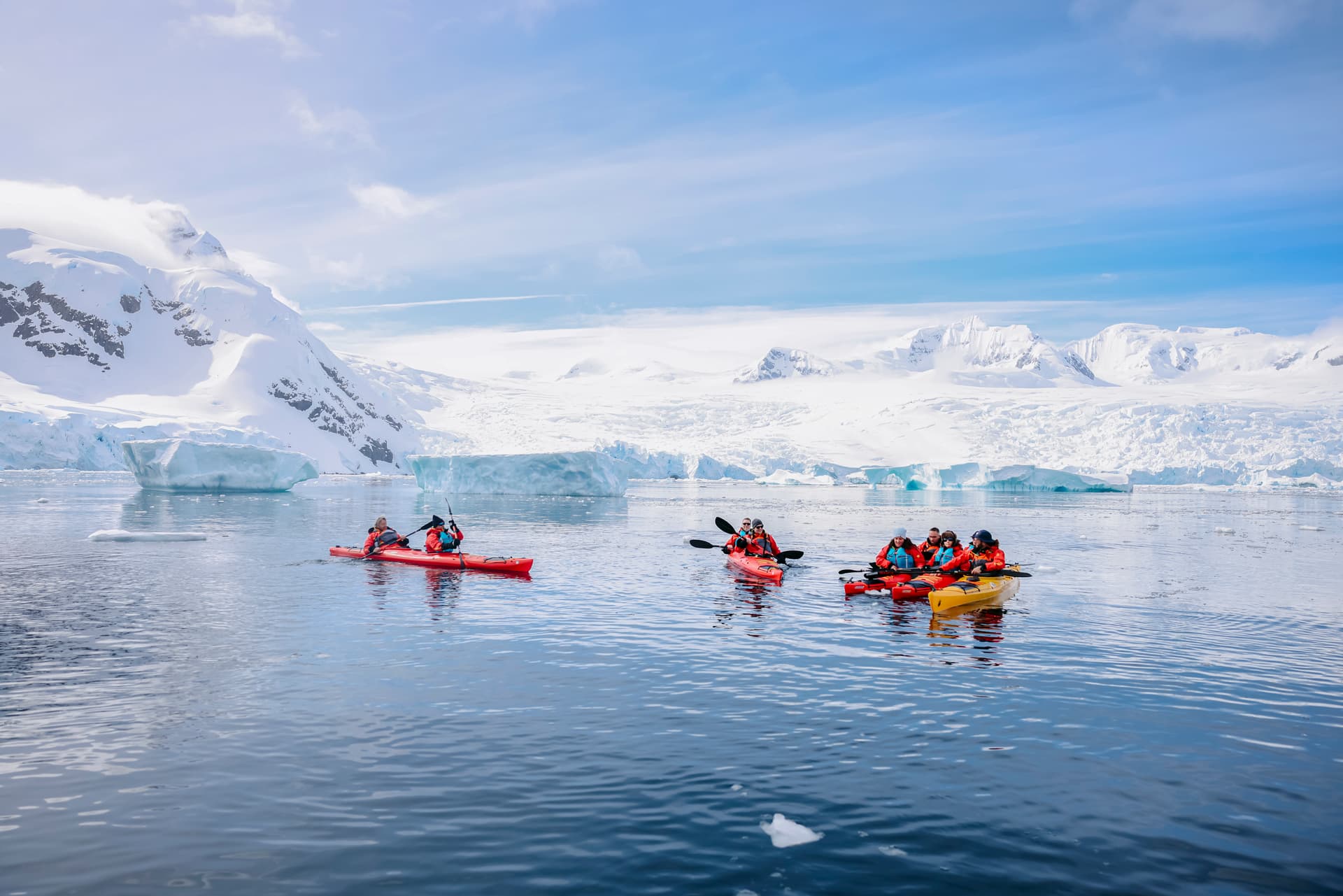
Kayaking offers one of the quietest yet most electrifying ways to explore these Polar regions. If the weather allows, we try to offer kayaking twice a day in locations where it's suitable. Safety is always a priority, so once your kayaking group head out, a safety Zodiac is always close by. Kayaks offer a relaxing, quiet experience, sometimes even attracting animals closer than a Zodiac would.
Do you need experience to kayak in Antarctica?
You will need prior experience and paddling skills for Swan Hellenic’s polar kayaking experiences. The activity takes place in a stable tandem kayak, with the expedition team selecting calm, suitable locations and providing a mandatory safety briefing before you set out. During an Antarctica kayaking expedition, you will travel by Zodiac to a sheltered location before exploring the coastline at a relaxed pace. Sea kayaking in Antarctica offers a unique perspective of icebergs, coastlines, and wildlife, with a safety Zodiac support boat remaining close throughout the experience.
What happens when you set off on a kayaking experience?
You’ll meet up with everyone in Basecamp to get into your dry suit around half an hour before heading out. You’ll take a Zodiac to a location that’s been scouted from the bridge, and get into your kayak. From there, the group will explore together, paddling at a leisurely pace.
What kind of briefing about kayaking do you do on board?
There are mandatory safety briefing for all guests, where we cover best practices, let guests know the inherent risks in kayaking, and explain how the program runs.
How do Swan Hellenic guests prepare for their kayaking adventures?
Guests prepare in the ship’s Basecamp. This is the place where everyone puts on their dry suits before heading out on the Zodiac boats (small inflatable RIB boats).
What should you wear when kayaking in polar regions?
For kayaking in Antarctica and the Arctic, you wear base and insulation layers beneath a dry suit provided for the experience. The dry suit forms the waterproof outer layer, so a large parka or snow pants are not needed while kayaking. Dry bags are also available for carrying personal items such as a phone.
Don’t know what a dry suit is? No problem!
A dry suit is like a Gore-Tex rain jacket but instead of a jacket, it's a one-piece. It's got built in socks, pants and a jacket, and there’s a Velcro strap at the neck and gaskets at the wrists to help keep water out. If you do go in the water, the only thing that really gets wet is your head and your hands.

How cold is kayaking in Antarctica?
Kayaking in Antarctica takes place in cold polar conditions, with a dry suit helping to keep you dry in the water. We only run kayaking excursions when weather conditions allow and it is safe to do so, but the temperatures vary by location and day. The experience is designed to let you focus on the surroundings rather than the cold. From a tandem kayak, you can observe icebergs and dramatic coastlines at close range while moving quietly through the water. The excursion usually lasts around one to two hours, depending on conditions.
Is kayaking in the Arctic dangerous?
Arctic kayaking with Swan Hellenic is carefully guided, with safety at the heart of every stage of the experience. Before setting out, all guests receive a mandatory safety briefing covering best practices, potential risks, and how the activity is conducted. A safety Zodiac stays with the kayaking group throughout, ready to provide assistance if needed. The Expedition Team also manages who paddles together. Swan Hellenic uses stable double kayaks with two separate cockpits, allowing a more experienced kayaker to sit in the rear with a less experienced participant in front. The group is accompanied by a kayak guide, while the safety Zodiac remains nearby — giving guests the confidence to focus on the quiet, immersive experience of Arctic kayaking.
What wildlife can you see while kayaking in Antarctica?
While kayaking in Antarctica, you may encounter penguins, seals, whales, and seabirds. Wildlife sightings are never guaranteed, as encounters depend entirely on what nature brings during your time on the water. One of the distinctive qualities of sea kayaking in Antarctica is the silence. Without the sound of a motor, you experience the landscape from a low, water-level perspective, sometimes allowing wildlife to come closer than it might during a Zodiac excursion.
What are the best locations for kayaking?
There are no specific locations that are the best because the experience is different every time. Somewhere might be sunny day one day, but foggy the next. Sometimes you’ll see whales everywhere, and other days there will be no whales. It depends on what nature wants to serve you on any given day.
What are the requirements for kayaking?
To take part in the kayaking programs, you will need to have previous kayaking experience. It’s very safe because you’re in a double kayak that's extremely stable, and we only go to locations that are calm. A double kayak has two cockpits in it, so it has seats for two people, which means we can put a more experienced person in the back and a less experienced person in the front.
Is kayaking with Swan Hellenic physically demanding?
Some people worry they won’t have the energy to kayak, but it’s not usually a problem. It’s not a strenuous activity, and guests won’t break a sweat while they’re doing it. We cruise along at the pace of the slowest person, exploring the most visually appealing part of a coastline.

What happens if you fall into the water when you're kayaking?
It's very rare that someone falls in. If you do, the dry suit and life jacket you're wearing means you'll just pop back up to the surface, where you'll be helped back into your kayak. If you fall into the water and decide you want to go back to the ship, your guides will organize a ride back to your ship.
How long do kayaking experience usually last?
One to two hours. Once the kayaking experience is done for the day, everyone meets back up with the Zodiac and heads back to the ship.

Thanks to James Roberts for his help with this blog post.